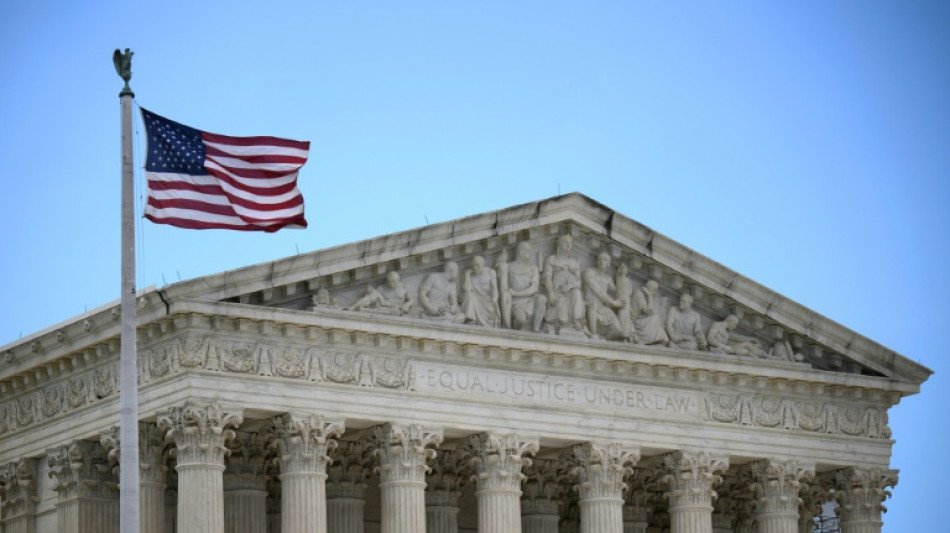
US Supreme Court weighs campaign finance case / Photo: Drew ANGERER - AFP/File


The US Supreme Court heard arguments on Tuesday in a Republican challenge to campaign finance rules that could impact next year's midterm elections.
Among those bringing the case is Vice President JD Vance, who joined when he was running for the Senate in 2022 and is now considered a potential candidate for the Republican presidential nomination in 2028.
At issue in the case brought by the Republican Party is limits on the amount of money political parties can spend in coordination with their candidates.
In Citizens United, a landmark 2010 case, the Supreme Court lifted restrictions on campaign spending by corporations, unions and other outside groups.
But political parties are still restricted, however, on how much they can spend on advertising, for example, in coordination with individual candidates.
Supporters of the law argue that it curbs potential corruption and prevents wealthy donors from funneling money through a political party to a candidate of their choice.
It was unclear during oral arguments on Tuesday how the court would rule although several of the six conservative justices on the nine-member court appeared inclined to strike down the restrictions.
"I am concerned...that the combination of campaign finance laws and this court's decisions over the years have together reduced the power of political parties as compared to outside groups, with negative effects on our constitutional democracy," said Justice Brett Kavanaugh, a conservative.
"You can give huge money to the outside group, but you can't give huge money to the parties, and the parties are very much weakened compared to the outside group," Kavanaugh said.
The three liberal justices were skeptical.
"Once we take off this coordinated expenditure limits, then what's left?" said Justice Sonia Sotomayor. "What's left is nothing, no control whatsoever."
Marc Elias, arguing for Democrats who oppose easing the rules, said lifting the spending restrictions would "convert the political parties into mere paymasters to settle invoices from campaign vendors."
"They will not be able to support activity that is long term in nature, because there will be an arms race that right now doesn't exist," Elias said.
"Coordinated party spending limits act as a buffer on how much money you can pump into directly paying the bills of a House or Senate campaign or a presidential campaign so that you have funds to do these other party building functions," he added.
The court is expected to issue its decision by the end of June, four months ahead of the midterm vote.
D.Silva--ECdLR