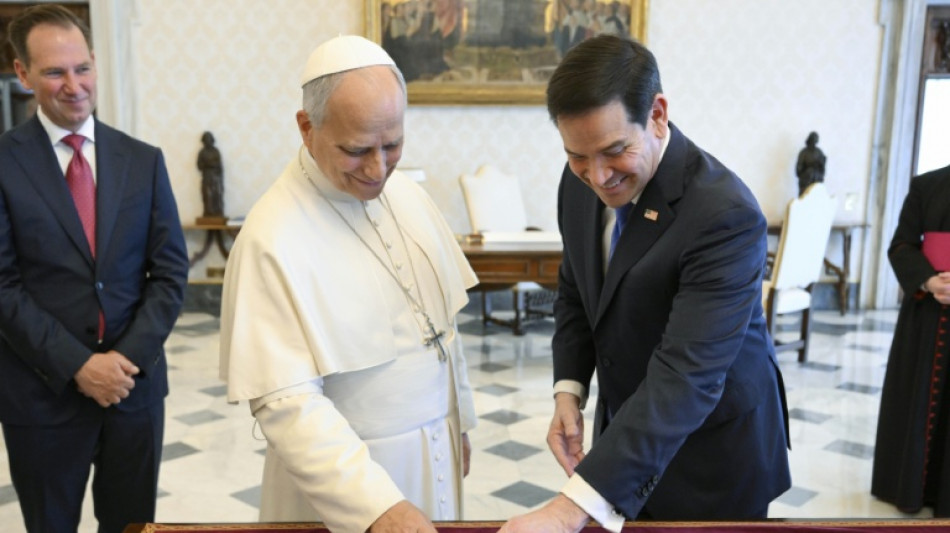
US underlines 'strong' Vatican ties after Rubio meets pope / Photo: Handout - VATICAN MEDIA/AFP
The US State Department underlined its "strong relationship" with the Vatican on Thursday after talks between top diplomat Marco Rubio and Pope Leo, weeks after Donald Trump's astonishing attack on the first US pontiff.
"The conversations today were friendly and constructive," a State Department official told AFP following the US secretary of state's private audience at the Vatican.
Rubio's visit comes after US President Trump accused Leo, the head of the world's 1.4 billion Catholics, of being "weak on crime and terrible for foreign policy" after he made critical comments about the Middle East war.
After the talks, US State Department spokesman Tommy Pigott said Leo and Rubio discussed the Middle East as well as their mutual interests in the Western Hemisphere -- a phrase used by the US to refer to Latin America.
"The meeting underscored the strong relationship between the United States and the Holy See and their shared commitment to promoting peace and human dignity," he said.
A US official confirmed that the Catholic Church's work in Cuba was discussed.
The Holy See has long played an active role in Cuban diplomacy, while Rubio -- a Cuban-American -- has led the US administration's efforts to bring major change to the communist-run country.
Rubio also met with Vatican Secretary of State Pietro Parolin, with whom he discussed subjects including religious freedom, according to Pigott.
- 'We'll listen to him' -
The US diplomat, a devout Catholic, had earlier sought to play down the rift between Trump and the pope, which sparked global headlines and risked alienating Catholic US voters.
The US ambassador to the Holy See, Brian Burch, told reporters this week it would likely be a "frank conversation".
For the Vatican's part, "we'll listen to him", Parolin had said on Wednesday, noting that Washington initiated the meeting.
The Trump administration had celebrated the election one year ago -- May 8, 2025 -- of Leo, the first US pontiff in history.
But its relations with the Holy See have since sharply deteriorated.
Trump's unprecedented attack came after Leo called for peace in the Middle East war launched by Israel and the United States.
The pontiff condemned a threat by Trump to destroy Iranian civilisation as "truly unacceptable".
Before leaving for Rome, Rubio said the trip had been planned before the clash, adding: "There's a lot to talk about with the Vatican."
On Thursday, a US source hailed the welcome extended to Rubio, saying it "exceeded expectations".
Rubio's motorcade entered the Vatican through the Arch of Bells, an honour normally accorded to heads of state, and he was greeted by the Swiss Guard.
- Pope being pope -
Despite the peace-making attempt, Trump again criticised the pope in an interview on Monday, alleging that Leo believes it is "OK for Iran to have a nuclear weapon".
"I think he's endangering a lot of Catholics and a lot of people," Trump said of the pontiff.
Asked about the comments on Tuesday, Leo said that the Catholic Church's mission was to "preach peace" and the Gospel.
"If anyone wishes to criticise me for proclaiming the Gospel, let them do so truthfully," he told reporters.
"The Church has spoken out against all nuclear weapons for years, so there is no doubt about that, and I simply hope to be heard for the sake of the value of God's word."
At an event on Wednesday, Parolin said that attacking the pope "seems a little strange to me", adding: "The pope is being the pope."
Leo's nationality means his words carry more weight in Washington than those of his predecessors -- and he has used them, notably criticising the Trump administration's crackdown on immigration.
The pope and Rubio met for the first time last year at the Vatican, alongside US Vice President JD Vance, a Catholic convert, just days after Leo's election.
G.Guzmán--ECdLR