'Fire calling the shots': France's blaze pushes crews to the brink / Photo: Alain JOCARD - AFP



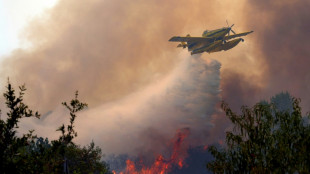
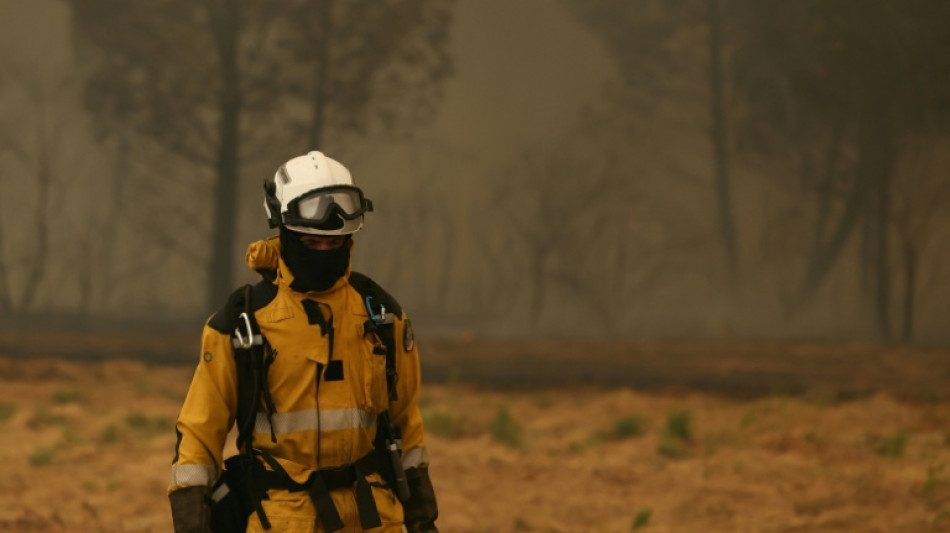
Plumes of smoke rose above a vast sea of pine trees outside Bordeaux as firefighters in gleaming helmets rushed to douse emerging flames before they could spread.
"It's intense, titanic," said Florian Lointier of the Paris Fire Brigade, an army unit dispatched to southwest France to help exhausted crews tackle the huge wildfire.
More than 5,000 firefighters, military personnel, police officers and volunteers have been battling the ferocious blaze, which has forced one of the largest evacuations in France's history and was 15 kilometres (nine miles) from Bordeaux's suburbs.
Overwhelmed firefighters say the blaze has been unpredictable and has generated a gigantic, untamable fire cloud, known as a pyrocumulonimbus, a phenomenon never before seen in France.
Faced with a blaze of such intensity, firefighters say they are powerless to control its path.
Eric Brocardi, spokesman for the National Federation of Firefighters, said emergency services have been engaged in a "David-versus-Goliath" battle against "a natural force beyond our control".
"The fire front is constantly changing position," he said. "We cannot fight it."
Instead, crews focus on protecting villages and towns, hoping rain may eventually come to their rescue.
On the southeastern flank of the wildfire, a new outbreak was detected, prompting the intervention of the Paris firefighters.
Their vehicles reversed down a sandy track not far from the A63 motorway, which has been closed to traffic. The engines remained running at all times, allowing crews to leave quickly if conditions suddenly deteriorated.
With hoses stretched through heather shrubs, the firefighters pushed about 20 metres into the pine forest.
Within minutes, they extinguished flames less than a metre high.
When they ran out of water, they beat back the fire with shovels, and sometimes even with their boots, before raking through the scorched ground to prevent it from reigniting.
"Open your jacket, it's too hot," one firefighter told a colleague as he unfastened his red protective gear, breathless from the effort of fighting the flames.
It was only 9:00 am (0700 GMT), but the heat was already oppressive.
- 'Chasing the fire' -
At their earlier point of intervention, the flames had already spread deeper into the forest, beyond the reach of vehicles primarily designed for urban firefighting operations.
Specialised wildfire units were immediately called in, notably to provide them with supplies.
"We're chasing the fire," said Lointier, whose unit is also tasked with protecting homes and sensitive sites.
A total of 2,500 firefighters, 1,500 military personnel and around 1,200 police have been deployed to battle the blazes in Gironde where the city of Bordeaux is located.
Firefighters in the region are equipped with off-road vehicles that enable them to make their way through the pine forests.
"Sometimes we go in with urban vehicles as well. We don't have a choice," said a female firefighter.
"The wind changes so much that the fire is the one calling the shots."
The wildfire spans dozens of kilometres, complicating efforts to reposition ground resources as winds change.
"With this fire, everything is complicated," said another firefighter, Guillaume Millet, pointing to the drought and vegetation weakened by this year's punishing heatwaves.
"When it reaches the treetops, the fire enters a phase where it becomes extremely powerful, and at that point we simply cannot stop it."
Water-bombing aircraft can only help reduce the intensity of the blaze, he said.
"That's why we often find ourselves with fire behind us while we're fighting the one in front of us."
Two hours after the intervention of the Paris firefighters at the edge of the blaze, the wind picked up.
A column of black smoke rose into the air. To stop the fire spreading further, crews lit a backfire, and within minutes a wall of flames was consuming vegetation across several metres.
But scarcely had the backfire been extinguished when, across the road where dozens of fire engines were parked, hoses started blasting water.
The fire was there, and within minutes it had spread to a ditch on the opposite side.
T.Tapia--ECdLR