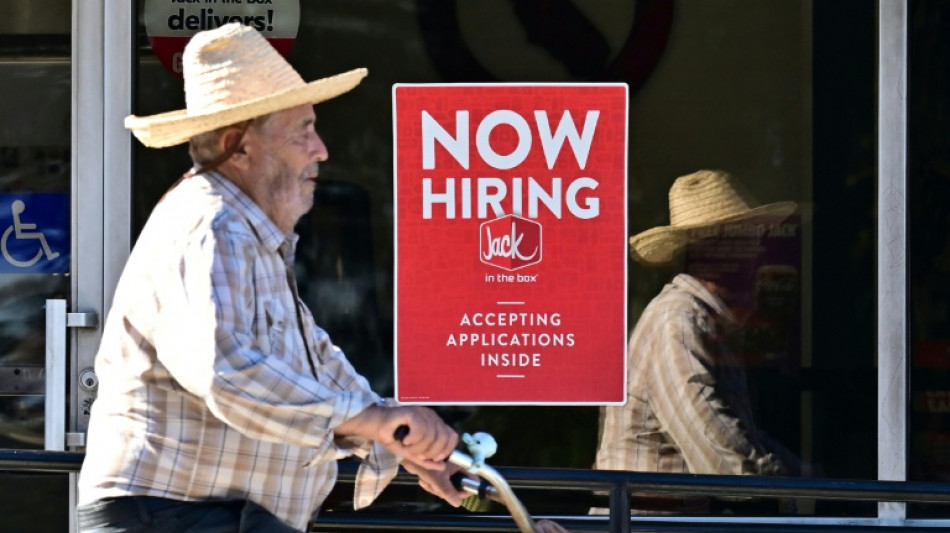
US private sector hiring rebounds in December but misses expectations / Photo: Frederic J. BROWN - AFP/File


Hiring in the US private sector bounced back in December, data from payroll firm ADP showed on Wednesday, but the figure still missed analyst expectations as the employment market cools.
Private sector hiring rose by 41,000 jobs last month, ADP said, but came in below the 48,000 expected in surveys of economists by Dow Jones Newswires and The Wall Street Journal.
However, this marked a rebound from a revised loss of 29,000 jobs in November.
All eyes have been on the jobs market in the world's biggest economy, with the US central bank cutting interest rates three times in a row in 2025 while employment weakened.
As households grapple with high costs of living, solid employment growth and salary increases can help soften the blow.
Although private sector hiring data can be volatile, investors will be monitoring it ahead of a government jobs report due Friday.
"Small establishments recovered from November job losses with positive end-of-year hiring, even as large employers pulled back," ADP chief economist Nela Richardson said.
The hiring rebound was led by education and health services, alongside leisure and hospitality.
But manufacturing shed jobs, as did the information sector and professional and business services.
In a call with reporters, Richardson noted that health services are expensive for many, while leisure and hospitality are discretionary services.
"These two sectors are consistent with a K-shaped economy where higher income consumers are driving spending," she added.
This refers to an uneven situation where higher-income Americans see wealth and salaries grow while lower-income households grapple with fewer gains and high costs.
Pay growth was 4.4 percent on a year-over-year basis in December, unchanged from November's rate, ADP said.
For workers who changed jobs, the pace of pay increases accelerated to 6.6 percent from 6.3 percent.
The US Federal Reserve is set to meet in late January to mull further changes to interest rates.
A rapidly deteriorating employment market could nudge it toward another rate cut sooner but for now, it is widely expected to keep rates steady at its next meeting.
"One month does not make a trend, but the increase in private payrolls as reported by ADP supports our forecast for the Federal Reserve to keep policy on hold until midyear," said economist Matthew Martin at Oxford Economics.
F.Fuentes--ECdLR