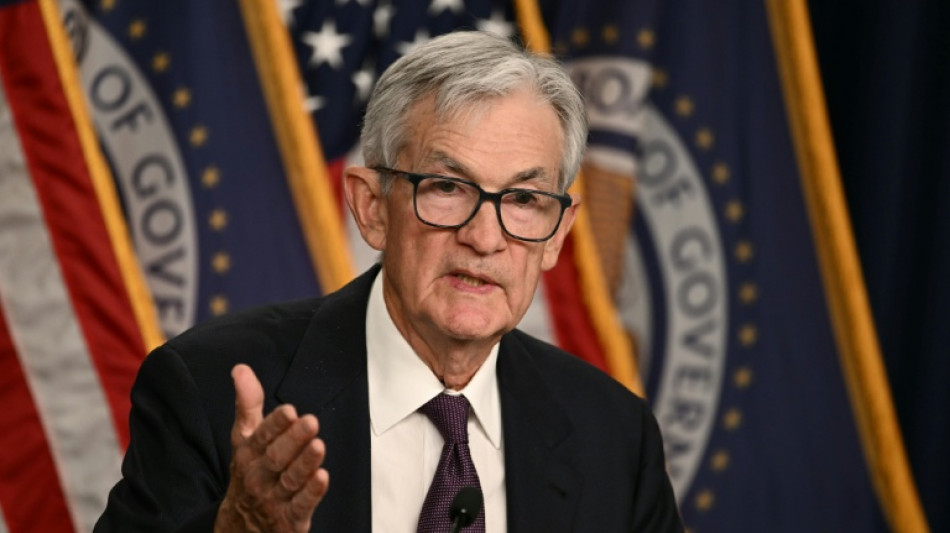
Oil slips, stocks rise as report says Trump willing to end war / Photo: Brendan SMIALOWSKI - AFP/File


Oil prices sank and most stocks rose Tuesday, following a report that indicated Donald Trump was willing to end the Iran war even if the key Strait of Hormuz remained closed.
But investors remain wary as the Wall Street Journal story came on the same day the US president threatened to destroy Iran's key oil export hub and desalination plants unless it accepts a deal, while also suggesting diplomacy was making headway.
The news comes as governments around the world scramble to implement measures to ease the burden of surging fuel prices while also looking to conserve energy, with one-fifth of global crude and gas passing through the waterway.
The Journal, citing administration officials, said Trump and his aides had come to the conclusion that a mission to reopen the waterway would extend the length of the mission past his four- to six-week timeline.
It added that he had decided to focus on battering Iran's missiles and navy, before looking to pressure Iran diplomatically to reopen the Strait.
Both main oil contracts fell Tuesday, though West Texas Intermediate and Brent were still sitting well above $100 a barrel.
And most equity markets rose. Hong Kong, Shanghai, Sydney, Singapore, Wellington and Jakarta were all up, while Tokyo fluctuated.
Seoul, Taipei and Manila fell.
However, Trump also threatened Monday to destroy Kharg Island, through which most of Iran's crude passes, if a peace deal is not reached.
He warned US forces would destroy "all of their Electric Generating Plants, Oil Wells and Kharg Island (and possibly all desalinization plants!)."
Destroying civilian infrastructure could constitute a war crime, experts say.
Iran has previously threatened to retaliate by targeting energy infrastructure and desalination plants in its Arab neighbours that host the US military, fanning fears of a wider conflict.
But Trump also said officials were speaking to a "more reasonable regime" in Tehran, which has denied any talks and accused the president of lying about negotiations as cover while preparing a ground invasion.
US Secretary of State Marco Rubio voiced hope for working with elements within Iran's government.
Market experts warned that any US ground operation or wider Iranian retaliation could send oil prices to levels not seen since July 2008, when Brent hit almost $150 a barrel.
- 'De-escalation and re-escalation' -
In a sign Iran was determined to keep control of Hormuz, state media reported Monday that a parliamentary commission had approved plans to impose tolls on vessels transiting it.
With Trump flipping between hope for talks and threats, analysts said investors were having to walk a tightrope.
"The market continues to be headline-driven as the Trump Administration has delivered a variety of messages surrounding de-escalation and re-escalation of the war in Iran," Wolfe Research's Chris Senyek said.
With the war now in its fifth week, governments are moving to shore up their economies.
Economy ministers and central bankers from the G7 club of rich countries met in Paris to discuss the war's effects, with many countries introducing energy-saving measures or cutting fuel taxes to help consumers.
Dubai said it will provide support worth more than $270 million to help businesses and families, while Norway will temporarily cut diesel and petrol taxes and Bangladesh ordered civil servants to switch off lights and turn down air conditioning to save power.
Sri Lanka announced a nearly 40 percent increase in electricity prices from Wednesday as it battles an energy shortage. Colombo has raised fuel prices three times this month, increasing them by more than a third, and has imposed a four-day working week in a bid to save energy.
"From here, the burden shifts from military outcomes to economic endurance. The question is no longer how high oil spikes, but how long elevated energy costs bleed into growth, margins, and consumption," said SPI Asset Management's Stephen Innes.
Federal Reserve boss Jerome Powell also provided a little support, saying Monday the bank could look past energy shocks because they "have tended to come and go pretty quickly" but monetary policy changes take time to flow through the economy.
While the spike in energy prices threatens to send inflation soaring again, he added that officials "feel like our policy is in a good place for us to wait and see how that turns out" and "inflation expectations do appear to be well-anchored beyond the short term".
- Key figures at around 0230 GMT -
Brent North Sea Crude: DOWN 1.3 percent at $106.04 a barrel
West Texas Intermediate: DOWN 0.7 percent at $102.22 a barrel
Tokyo - Nikkei 225: DOWN 0.1 percent at 51,820.30 (break)
Hong Kong - Hang Seng Index: UP 0.5 percent at 24,869.71
Shanghai - Composite: UP 0.3 percent at 3,935.05
Euro/dollar: UP at $1.1474 from $1.1460 on Monday
Pound/dollar: UP at $1.3207 from $1.3183
Dollar/yen: UP at 159.71 yen from 159.69 yen
Euro/pound: DOWN at 86.88 pence from 86.93 pence
New York - Dow: UP 0.1 percent at 45,216.14 (close)
London - FTSE 100: UP 1.6 percent at 10,127.96 (close)
A.González--ECdLR