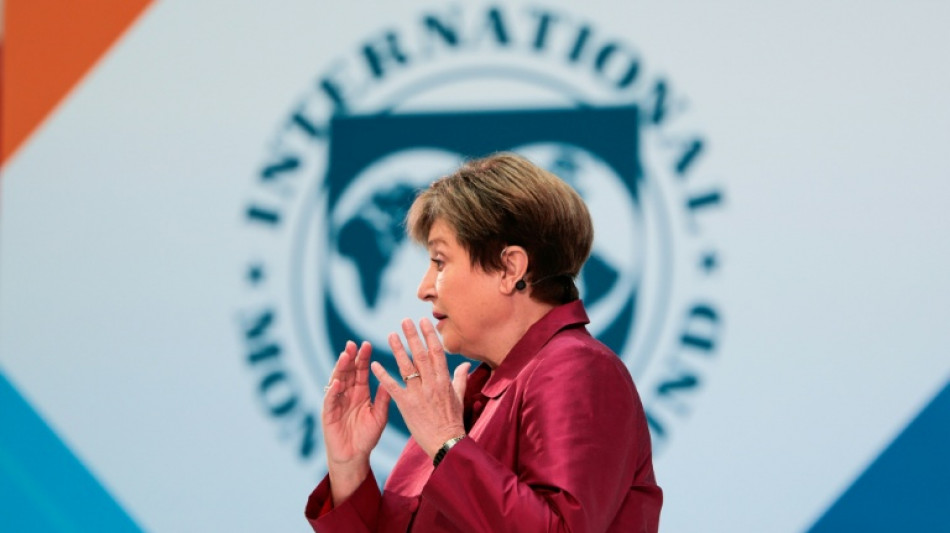
IMF to cut global growth forecast due to Mideast war / Photo: Kent Nishimura - AFP


The International Monetary Fund will lower global growth forecasts due to the Middle East war, its chief said Thursday, warning of the conflict's "scarring effects" despite a fragile ceasefire.
"Even in a best case, there will be no neat and clean return to the status quo ante," IMF managing director Kristalina Georgieva said.
Georgieva said that -- even in the fund's "most hopeful scenario" -- spiraling energy costs, infrastructure damage, supply disruptions and a loss of market confidence meant growth would be less than expected.
The IMF also anticipates having to provide up to $50 billion in immediate financial assistance to countries affected by the war, with food insecurity set to affect at least 45 million people.
"Given the spillovers from the war, we expect near-term demand for IMF balance-of-payments support to rise by somewhere between $20 billion and $50 billion, with the lower bound prevailing if ceasefire holds," Georgieva said.
The IMF chief was kicking off the annual Spring Meetings co-hosted by the International Monetary Fund and the World Bank in Washington, which bring together top economic policymakers from around the world.
The US-Israel war on Iran, launched on February 28, has engulfed the Middle East in violence, snarled supply chains and sent oil prices surging after Tehran virtually blocked the Strait of Hormuz.
Tehran and Washington have traded accusations of violations of the ceasefire terms, with talks aimed at a more durable peace slated for Saturday.
Georgieva highlighted the "asymmetric" effects of the crisis, hitting low-income energy importers much harder than others.
"Spare a thought for the Pacific Island nations at the end of a long supply chain, wondering if fuel still reaches them in the wake of such a severe disruption," she said.
- Global inflation -
On Wednesday, the World Bank said the Middle East -- which has seen retaliatory Iranian strikes hit countries across the Gulf and Israeli attacks in Lebanon -- saw "a serious and immediate economic toll" from the war.
Excluding Iran, overall regional economic growth was expected to slow to just 1.8 percent in 2026 -- a downgrade of 2.4 percentage points from before the war, the Bank said.
The IMF is also expected to revise global headline inflation upwards due to the oil price and supply chain shocks associated with the war.
On Wednesday, the heads of the IMF, World Bank and World Food Programme (WFP) met in Washington to discuss the economic and food security impacts of the conflict.
"Sharp increases in oil, gas, and fertilizer prices, together with transport bottlenecks, will inevitably lead to rising food prices and food insecurity," said a joint statement on the meeting.
The IMF and World Bank have also formed a coordination group to address the energy market impacts of the war. A top-level meeting of that body will take place on Monday.
As part of the meetings, the IMF will release its annual Fiscal Monitor report, which is expected to flag rising government debt as countries tackle repeated economic shocks.
In a new report this week, the IMF detailed the economic costs of war, estimating that output in countries where fighting takes place drops by three percent at the outset, "and continues falling for years."
An earlier report on the Iran war said "all roads lead to higher prices and slower growth," and highlighted the impact of a severely disrupted fertilizer supply chain on food security.
"Low-income countries are especially at risk of food insecurity; some may need more external support -- even as such assistance has been declining," the report said.
S.Salazar--ECdLR