Yemen separatists announce two-year independence transition in shock move / Photo: - - AFP



Yemen's UAE-backed separatists announced a two-year transition to an independent state on Friday after seizing swathes of territory in a lightning offensive that triggered deadly airstrikes by a Saudi-led coalition.
The surprise announcement means Yemen, which was divided into North and South from 1967 to 1990, could again be split by January 2028. The separatists plan to call the new country "South Arabia".
Southern Transitional Council (STC) president Aidaros Alzubidi said the transitional phase would include dialogue with Yemen's north -- controlled by Iran-backed Houthi rebels -- and a referendum on independence.
But on a day when seven separatist fighters died in airstrikes, he warned the group would declare independence "immediately" if there was no dialogue or if southern Yemen again came under attack.
"We announce the commencement of a transitional phase lasting two years, and the Council calls on the international community to sponsor dialogue between the concerned parties in the South and the North," Alzubidi said in a televised address.
"This constitutional declaration shall be considered immediately and directly effective before that date if the call is not heeded or if the people of the South, their land, or their forces are subjected to any military attacks," he added.
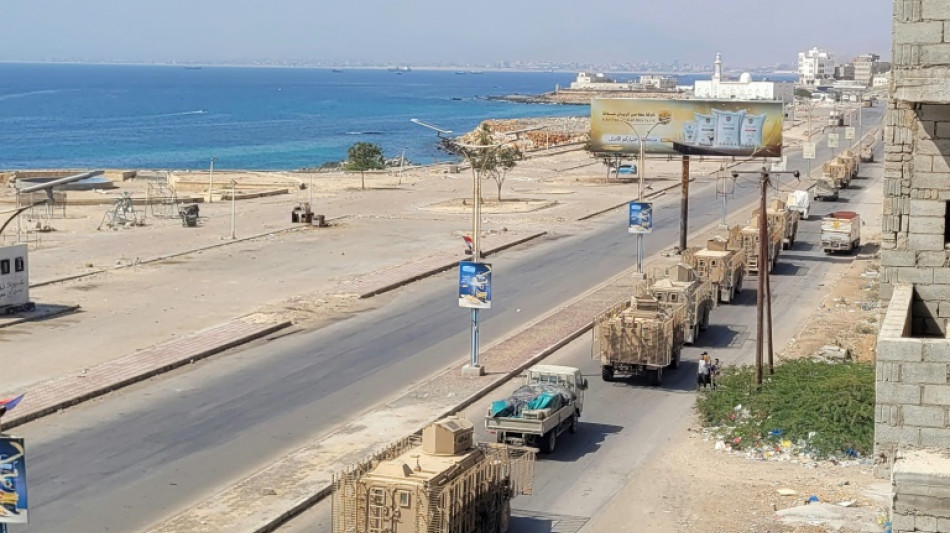
STC forces grabbed much of resource-rich Hadramawt, bordering Saudi Arabia, and neighbouring Mahra province on the Omani frontier, in a largely unopposed advance last month.
Saudi Arabia and the United Arab Emirates have for years supported rival factions in Yemen's fractured government territories. But the STC's offensive has angered Riyadh and left the oil-rich Gulf powers at loggerheads.
- 'Existential' war -
Following repeated warnings and airstrikes on an alleged UAE weapons shipment this week, the Saudi-led coalition targeted military bases and an airport in an escalated attack on Friday.
Mohammed Abdulmalik, head of the STC in Wadi Hadramaut and Hadramaut Desert, said seven air strikes hit the Al-Khasha military camp, killing seven and wounding more than 20.
Further strikes targeted other sites in the region and the airport and military base in Seiyun, an STC military source and eyewitnesses told AFP.
The deaths are the first from coalition fire since the STC's campaign began.
The group's military spokesman said it was in an "existential" war with Saudi-backed Yemeni forces, characterising it as a fight against radical Islamism -- a longtime preoccupation of the UAE.
The air raids came shortly after pro-Saudi forces launched a campaign to "peacefully" take control of military sites in Hadramawt.
"This operation is not a declaration of war, nor an attempt to escalate tensions," Hadramawt governor Salem Al-Khanbashi, also leader of the province's Saudi-backed forces, was quoted as saying by the Saba Net news agency.
Saudi sources confirmed the strikes were carried out by the Saudi-led coalition, which also nominally includes the UAE and was formed in 2015 in a vain attempt to dislodge the Houthi rebels in Yemen's north.
A source close to the Saudi military warned the strikes "will not stop until the Southern Transitional Council withdraws from the two governorates".
- Rival factions -
The wealthy Gulf states formed the backbone of the military coalition aimed at ousting the Houthis, who forced the government from the capital Sanaa in 2014 and seized areas including most of Yemen's population.
But after a brutal, decade-long civil war, the Houthis remain in place and the Saudis and Emiratis are backing different factions in the government-held territories.
The Yemeni government, based in Aden, comprises a fractious coalition of groups including the STC, united by their opposition to the Houthis.
The UAE, which withdrew most of its troops from Yemen in 2019, pledged to pull out the remainder after Tuesday's coalition airstrikes on its shipment at Mukalla port, despite denying it contained weapons.
On Friday, a UAE government official confirmed all troops had left, adding that Abu Dhabi "remains committed to dialogue, de-escalation, and internationally supported processes as the only sustainable path to peace".
E.Mendoza--ECdLR