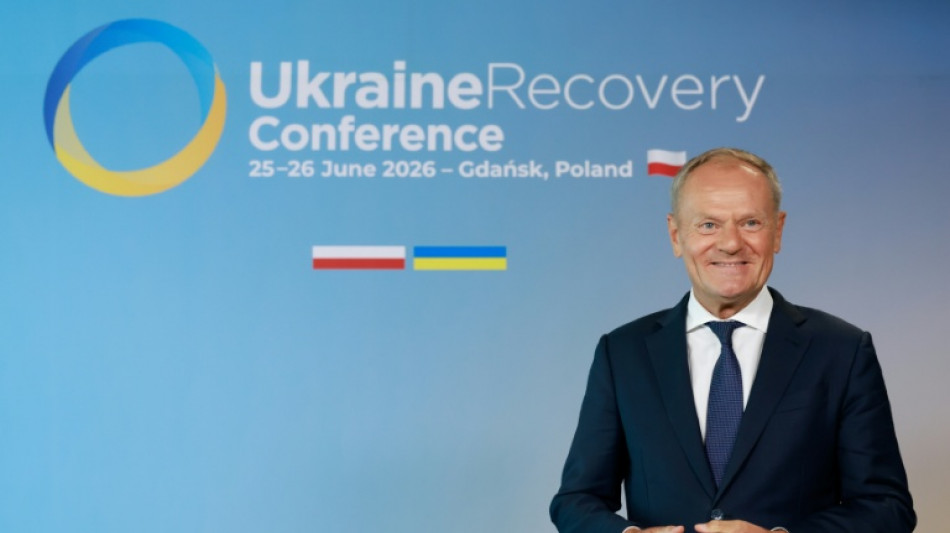
Poland, Ukraine tone down dispute at reconstruction conference / Photo: Wojtek RADWANSKI - AFP
Poland and Ukraine struck a conciliatory tone Thursday as they opened the annual Ukraine Recovery Conference in the Polish port of Gdansk after weeks of squabbling over historical differences -- albeit without President Volodymyr Zelensky.
Polish Prime Minister Donald Tusk called on the West to believe a post-war Ukraine will "rise from the ruins" like his native city Gdansk, largely destroyed during World War II, as he tried to dampen the diplomatic spat with Kyiv.
Ukraine's economy has been decimated by the Russian invasion and requires hundreds of billions of dollars of investment in reconstruction.
The conference opened under heavy security security after weeks of uncertainty over whether it would take place at all.
Zelensky had infuriated Poles by signing a decree naming a military unit after the WWII UPA nationalist insurgents, who took part in massacres against Poles in the 1940s.
"We can build the future only on truth, on mutual respect, on an understanding of history," Tusk said at the conference.
Speaking in the fifth year of Moscow's invasion of Ukraine, Tusk called on Kyiv's allies to "believe" that "the words 'after the war' will come true one day'."
Zelensky normally attends the annual conference, aimed at boosting investment into Ukraine, but skipped the Gdansk event amid the historical row.
Kyiv sent Prime Minister Yulia Svyrydenko instead, with a string of European leaders and EU chief Ursula von der Leyen also attending the landmark conference.
- Anti-Ukraine mood -
Ukraine's Svyrydenko also struck a friendly tone, without mentioning the historical disagreements.
"Thank you for your help when it was the most urgent time to support us," she told the Polish audience.
Poland took in over a million Ukrainian refugees after Russia invaded in 2022 and turned into a logistics hub for Western military aid flowing into Ukraine.
Warsaw has throughout the war said it wants Kyiv to one day join the EU.
But as the conflict has dragged on, nationalist parties in Poland have built on historical differences to fuel anti-Ukrainian sentiment.
According to a recent opinion poll, 59.7 percent of Poles now oppose Ukraine's accession to the EU.
Poland itself joined the EU in 2004 and has presented itself as a model for how Kyiv could also reform to join the bloc.
- Heavy security -
Gdansk was under heavy security for the event -- with police and some soldiers patrolling the streets.
Kyiv warned that Moscow -- which has revelled in the Polish-Ukrainian dispute -- could carry out "provocations" in Ukraine "using Polish symbols" during the conference.
Ukraine needs more than $500 billion to repair the damage caused by Russia's invasion and is trying to whip up international support for investment.
Poland hopes its companies will build on their geographical closeness and not be overshadowed by Westerners when a peace deal is eventually reached and businesses can start pouring into Ukraine.
In the stands of Gdansk's Amberexpo, Polish business people hoped the political arguing would not affect potential deals.
"From the business side, we see no problems," said Michal Rzepnikowski, of the Endolink SA firm that ships Polish prosthetics into Ukraine.
The company mostly brought humanitarian aid into Ukraine at the start of the war but has turned into a business operation, taking medical equipment into hospitals and rehabilitation centres.
- Reconstruction talks amid distant peace -
"We want to help and develop business," Rzepnikowski said of the diplomatic row.
"But of course it does resonate in our relations with Ukraine and it does come up in conversations. But both sides reach the conclusion that it is not a priority during the war," he said.
From Ukrainians, there was some optimism that Moscow's offensive has significantly slowed in recent months.
"This year we've seen advances on the frontline," said Valery Shyrokov, a soldier in a Ukrainian unit of ex-artists, recently back from the front.
"We are looking with positivism into the future. We think we are getting there," he added.
Russian President Vladimir Putin has refused to drop hardline demands, insisting his forces will capture the rest of the eastern Donbas region before the war can end.
L.Martínez--ECdLR